

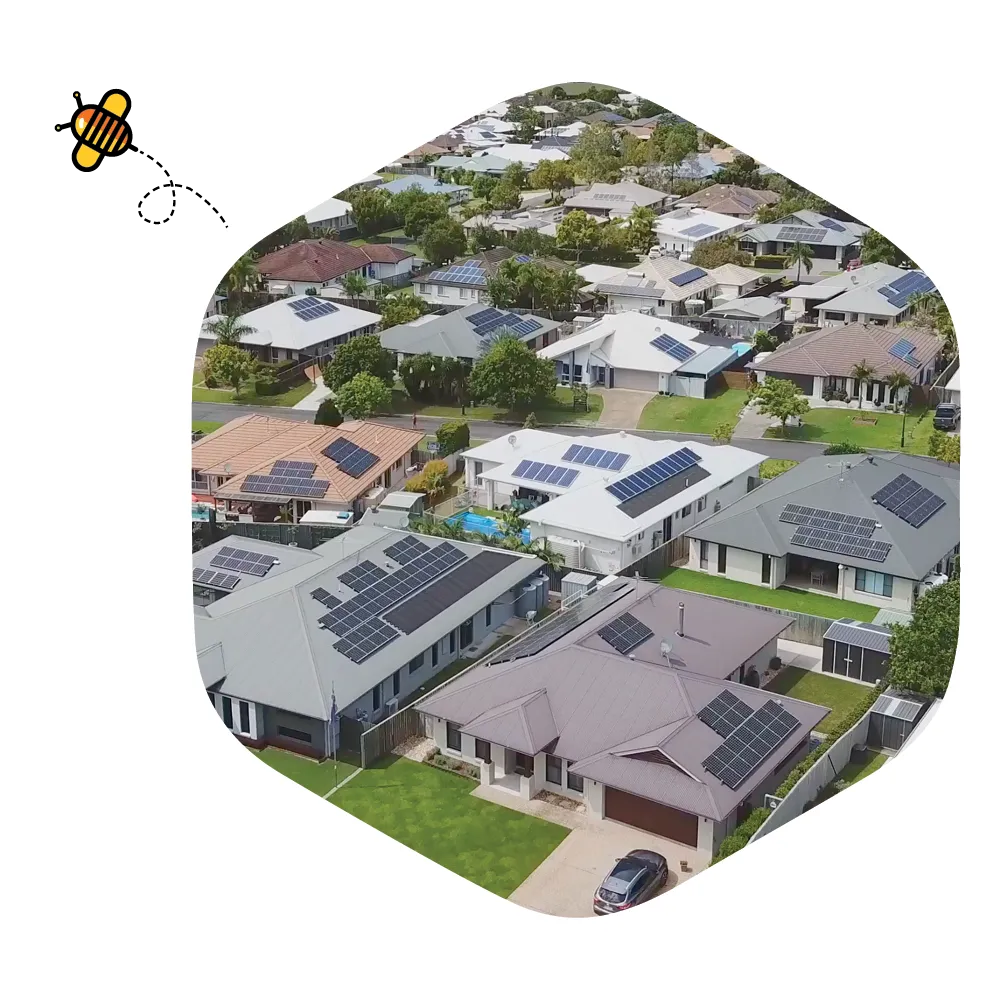
Rebates across Australia
What support is available for solar and batteries?
Federal incentives can reduce the upfront cost of eligible rooftop solar and home batteries across Australia. State programs may add targeted discounts, finance or incentives for sharing stored energy, depending on where you live and your circumstances.
Start with the federal programs below, then explore the guide for your state or location. A discount reduces your cost; a loan spreads repayments; a feed-in tariff pays for exported electricity. They are different benefits and should be compared separately.
| Support | What it does | Where it applies |
|---|---|---|
| Federal solar STCs | Reduce the cost of eligible rooftop solar | Across Australia |
| Cheaper Home Batteries Program | Discounts eligible solar-connected batteries | Across Australia |
| NSW support | Loans, a forthcoming targeted discount, VPP and apartment battery incentives | Eligibility varies by program |
| Queensland rental solar rebate | Up to $3,500 for eligible rental properties | Targeted Queensland program |
Federal solar support
How does the solar discount work?
The Small-scale Renewable Energy Scheme (SRES) allows eligible rooftop solar systems to create small-scale technology certificates, or STCs. You can usually assign these certificates to your installer or agent in exchange for an upfront discount, shown on your quote.
The certificate calculation depends on your system size, postcode zone and installation year. In 2026, the maximum solar deeming period is five years. It drops to four years in 2027 and decreases annually until the scheme ends in 2030.
For the current small-scale solar category, systems must be no more than 100 kW and produce less than 250 MWh annually, as well as meeting equipment and installation requirements.

Why does your postcode matter?
Solar zones follow postcode boundaries, not state borders. Sydney, Brisbane, the Gold Coast, Adelaide and Perth are in Zone 3, while Melbourne is in Zone 4. Check the actual installation postcode before comparing rebates.
Check the current program rules: CER certificate calculations; Eligible solar systems.
Federal battery support
How does the battery discount work?
The Cheaper Home Batteries Program began on 1 July 2025. It provides support designed to reduce the upfront cost of eligible solar-connected batteries by around 30%, with the actual amount depending on the system and certificate value.
The discount is based on usable battery capacity and an installation-date factor. Since 1 May 2026, larger capacity bands receive a lower rate of support. There is no household income test for this federal program.
For May–December 2026 installations, the STC factor is 6.8. A 10 kWh usable battery creates 68 certificates. At an illustrative $37 each, the certificate value is $2,516 before any applicable fees.

| Usable capacity band | Share of STC factor |
|---|---|
| First 14 kWh | 100% |
| Above 14 kWh to 28 kWh | 60% |
| Above 28 kWh to 50 kWh | 15% |
| Above 50 kWh | No certificates on this portion |
What are the main eligibility requirements?
- A battery system of 5–100 kWh nominal capacity, with certificates available on the first 50 kWh of eligible usable capacity.
- Connection to new or existing eligible solar. A battery that only stores grid electricity does not qualify.
- Approved equipment and an appropriately accredited Solar Accreditation Australia installer, with the required electrical certification.
- For a grid-connected system, the battery and inverter must be technically capable of joining a virtual power plant. Joining one is optional.
- Previous claims matter. The federal program supports one battery system per premises and is not a repeat discount for later additions to a system already supported.
Check the current program rules: Cheaper Home Batteries Program; Federal battery eligibility.
State and local support
What changes between locations?
New South Wales
NSW’s previous standalone household battery installation incentive was suspended from 1 July 2025. Current options include Home Energy Saver loans, a targeted discount stream listed as coming soon, an incentive to join a VPP and a separate apartment-building battery incentive. Each has its own eligibility rules.
Explore NSW battery rebates, loans and incentives.
Queensland
Battery Booster has closed. Federal programs remain the main installation support for owner-occupiers, while eligible landlords can access the separate Supercharged Solar for Renters program. Retailer VPP offers and feed-in tariffs are different from installation rebates.
Explore Queensland solar and battery incentives.
Gold Coast
Gold Coast households can use the same federal programs, with eligible rental properties also able to qualify for Queensland’s targeted solar support. Local network connection requirements and your electricity plan affect how a system can operate.
For other states and territories, check the Australian Government rebate finder for local programs. Eligibility for a government program does not by itself confirm Nectr installation availability in your area.
Planning your system
What else affects the value of your system?
Feed-in tariffs credit the solar electricity you export. They are an ongoing part of your electricity plan, rather than an upfront installation rebate. Rates and tariff arrangements vary by location and retailer.
A battery can shift surplus solar into the evening, but the benefit depends on your generation, consumption, electricity prices, battery losses and installed cost. Size the system around your household rather than the maximum rebate.
If you are considering a VPP, compare the upfront payment with ongoing energy rates, provider access to your battery and contract conditions. Federal VPP capability requirements do not mean you must join a VPP.

What should you check on a quote?
- The panels, inverter and battery model, including nominal and usable battery capacity.
- Each incentive separately, its eligibility requirements and any paperwork you need to complete.
- The expected installation date, certificate value, fees and remaining amount payable.
- Network approval, export limits, warranty and any switchboard or backup-power work.
Check the current program rules: NSW Home Energy Saver; Queensland Supercharged Solar for Renters.
About these figures
Certificate values, eligibility and program availability can change. Dollar examples are illustrations, not guaranteed rebates or a Nectr offer. Ask for an itemised quote showing the applicable discounts, any fees and your final installed price.
Information checked 15 September 2026.
